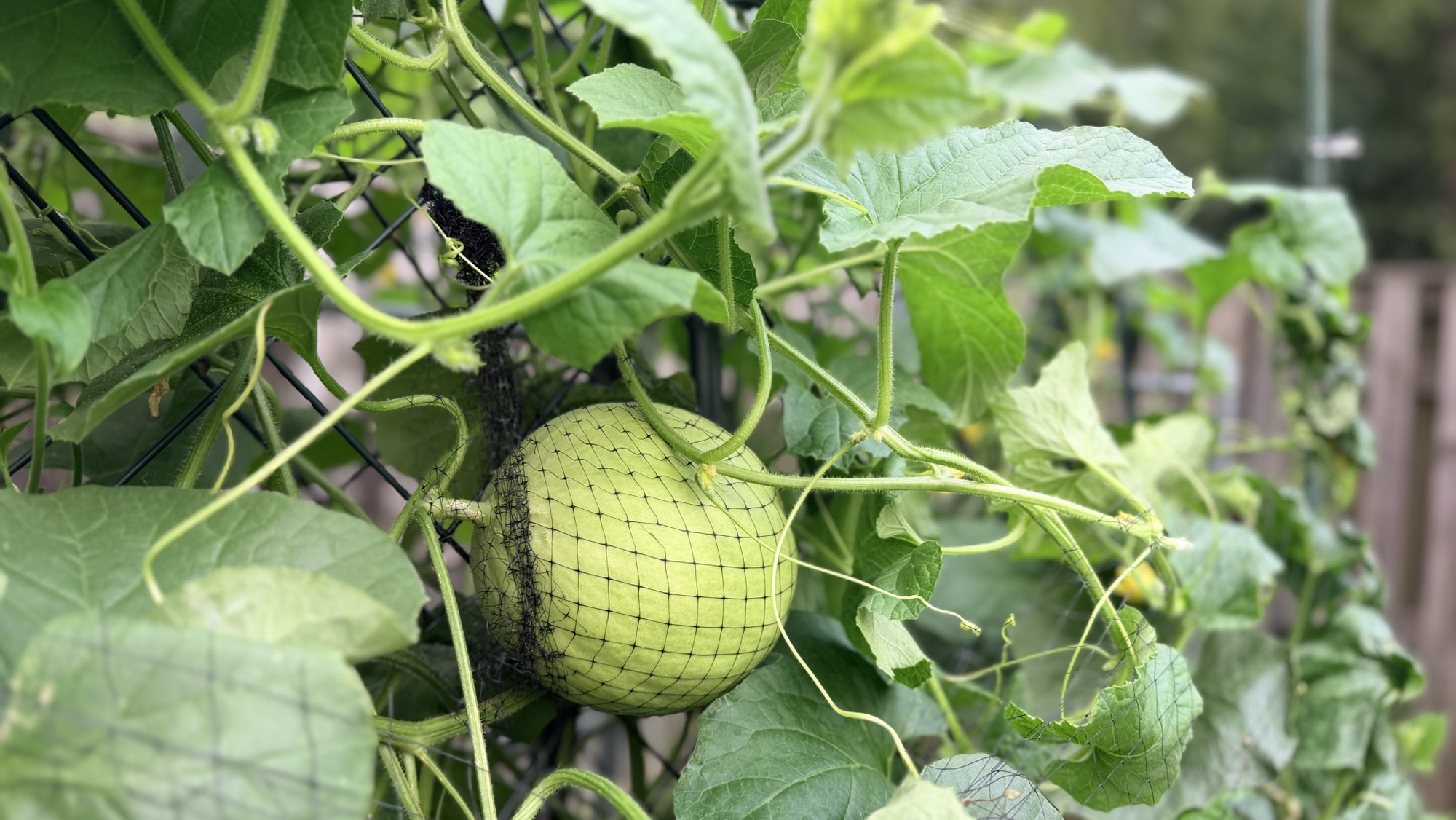
Few garden harvests feel as exciting as picking a fully ripened melon from your own backyard.
Melons require warmth, room to grow, and a little patience, but the reward is worth it. A melon allowed to ripen properly on the vine develops a sweetness and fragrance that can be difficult to find in fruit harvested early for shipping.

In my Maryland Zone 7 garden, I grow melons vertically because I do not have enough room to let long vines spread across the ground. An A-frame trellis allows me to use the space more efficiently while making the fruit easier to find and support.
I have grown both green- and orange-fleshed honeydew melons, and one successful season gave me six fruits from a relatively small growing area. Experiences like that remind me that you do not need a large garden to enjoy homegrown melons—you simply need the right variety, plenty of warmth, and a plan for managing the vines.
Here is everything you need to know about growing melons successfully.
What Are Melons?
Melons are warm-season vining plants in the cucurbit family, which also includes cucumbers, squash, pumpkins, and watermelons.

Common garden melons include:
- Cantaloupe
- Muskmelon
- Honeydew
- Charentais melon
- Galia melon
- Canary melon
- Asian melon
- Specialty and miniature melons
Although watermelon is commonly called a melon, it belongs to a different genus and has somewhat different ripening signs. This guide focuses primarily on muskmelons, cantaloupes, honeydews, and similar sweet melons.
Why Grow Your Own Melons?
Homegrown melons offer several advantages:
- Fruit can ripen fully on the vine.
- You can grow unusual varieties that are rarely sold locally.
- Compact and miniature types can fit into smaller gardens.
- Vines can be trained vertically.
- Freshly harvested melons have excellent fragrance and flavor.
- A few healthy plants may produce several fruits.
Melons can be more demanding than lettuce or beans, but they are extremely rewarding once you learn what they need.
Choosing the Right Melon Variety
Your variety choice can determine whether the plants have enough time and space to produce mature fruit.
Consider:
- Days to maturity
- Fruit size
- Vine length
- Disease resistance
- Heat requirements
- Whether the variety is suitable for trellising
- Your average frost-free growing season
Gardeners in shorter-season climates should look for varieties described as:
- Early maturing
- Short season
- Compact
- Miniature
- Suitable for northern gardens
Smaller melons usually ripen more quickly and are easier to support on a trellis.
Cantaloupe vs. Muskmelon vs. Honeydew
These names are sometimes used interchangeably, but they describe different melon types.
Muskmelons and Cantaloupes
The melons commonly called cantaloupes in American gardens usually have:
- Netted or textured rinds
- Orange flesh
- A strong fragrance when ripe
Muskmelons and cantaloupes are a little easier to judge than honeydew because they give you a pretty obvious sign when they’re ready. 🍈
As the fruit ripens, look for the background color beneath the netting to change from green to a creamy yellow or tan.
One of the best clues is the “slip.” At full slip, the stem should separate easily from the melon with very little pressure instead of needing to be pulled or cut.
You can also check the blossom end for a slight give and smell the melon for that wonderful sweet, musky aroma.
I like to look for several signs together before harvesting because varieties can behave a little differently.
And when that melon practically falls into your hand after months of waiting… that’s a pretty satisfying garden moment.
Honeydew Melons
Honeydews generally have:
- Smooth rinds
- Green, white, or orange flesh
- A milder aroma
Honeydew melons don’t give us the same easy “slip” signal that many muskmelons do, so knowing when to harvest can be a little trickier.
Instead of waiting for the melon to detach easily from the vine, I look at several clues together—rind color, skin texture, aroma, and the characteristics of the specific variety I’m growing.
This is also why knowing your variety matters. Not every melon tells you it’s ready in exactly the same way.
To tell if a honeydew melon is ready to harvest, look for several signs rather than relying on just one.
The rind often changes from bright green to a creamier yellow or pale golden color as the melon matures. Depending on the variety, the surface may also develop a slightly waxy feel.
I also check the blossom end, opposite the stem. A ripe melon may have a little give when gently pressed rather than feeling completely hard.
And don’t forget to pick it up—a mature honeydew should feel heavy for its size, which is a good indication of all that juicy goodness inside. 😍
Since varieties can ripen differently, I like to use several of these clues together before deciding it’s finally harvest time.
When to Plant Melons
Melons are tender warm-season plants. Frost damages them, and they grow poorly in cold soil.
Wait until:
- All danger of frost has passed.
- The soil has warmed.
- Nights are consistently mild.
- The weather forecast shows stable warmth.
In Central Maryland, I generally plant cantaloupe and muskmelon seeds outdoors from around mid-May through mid-June, depending on the weather.
Melons love warmth, so planting them too early doesn’t necessarily give you a head start. Seeds and young plants sitting in cold soil may grow slowly, become stressed, or struggle with their roots before warm weather arrives.
I’ve learned that sometimes waiting is actually the faster way to grow. Once the soil and weather are consistently warm, melons can take off surprisingly quickly.
With warm-season crops, being the first one to plant isn’t always the goal. Giving them the conditions they actually want can make a much bigger difference.
Starting Melon Seeds Indoors
Starting seeds indoors can provide an earlier harvest, especially in climates with a limited warm season.
Start melon seeds approximately three to four weeks before you plan to transplant them outdoors.
Avoid starting them too early. Melons grow quickly and dislike having their roots disturbed.
Use:
- Individual pots
- Biodegradable pots
- Soil blocks
- Large seed-starting cells
If you’re starting melons indoors, plant one or two seeds per container, then keep the strongest seedling if both germinate. 🌱🍈
Starting melons indoors can give you about a two- to four-week head start, which can be helpful when you have a shorter growing season.
The important thing to remember is that melons don’t like having their roots disturbed. Damaged roots can cause transplant shock, slow their growth, and sometimes weaken the plant significantly.
I prefer starting them in individual containers so I can transplant the entire root ball with as little disturbance as possible.
With melons, a head start is only helpful if you can keep those roots happy along the way.
How to Harden Off Melon Seedlings
Seedlings started indoors must adjust gradually to outdoor conditions.
Over approximately one week:
- Begin with a few hours in a sheltered, shaded area.
- Increase outdoor time gradually.
- Introduce gentle morning sunlight.
- Protect seedlings from strong wind and cold nights.
- Increase sun exposure each day.
- Transplant only after the weather is warm.
Handle the roots and stems carefully. Melon seedlings can be more sensitive to transplant shock than many other vegetables.
Can You Direct Sow Melons?
Yes.
Direct sowing works well when the soil has warmed and your growing season is long enough.
Plant seeds:
- Approximately ½ to 1 inch deep
- In warm, moist soil
- After frost danger has passed
- Near the support if you plan to trellis them
Sow two or three seeds in each planting area, then thin to the strongest seedling after germination.
Direct-sown plants avoid transplant shock, although they may produce later than indoor-started seedlings.
How Much Sun Do Melons Need?
Melons are sun-loving plants.
Give them at least six hours of direct sunlight each day, although eight to ten hours is even better for vigorous vines, flowering, and fruit production.
If you’re working with a small garden, pay attention to where shadows fall throughout the day. Melon vines can take up quite a bit of room, so choosing a sunny location from the beginning can make a big difference.
More sunshine means more energy for the plant to put toward growing those sweet melons you’ve been waiting all summer to harvest
Insufficient sunlight may cause:
- Weak vines
- Fewer flowers
- Poor fruit set
- Slow ripening
- Less-sweet fruit
Choose one of the warmest and brightest locations in your garden.
The Best Soil for Melons
Melons grow best in soil that is:
- Fertile
- Loose
- Well-drained
- Rich in organic matter
- Warm
- Able to hold consistent moisture
Before planting:
- Remove weeds.
- Loosen compacted soil.
- Add finished compost.
- Mix in a balanced fertilizer if needed.
- Water the bed before planting.
Avoid low areas that remain wet after heavy rain. Melon roots need moisture, but they can struggle in waterlogged soil.
Warming the Soil Before Planting
Melons grow much better in warm soil.
You can help warm the planting area by:
- Preparing the bed early
- Choosing a sunny location
- Using black plastic temporarily
- Using dark biodegradable mulch
- Planting in raised beds
- Covering the bed with a low tunnel before planting
Remove or cut openings in plastic coverings appropriately before transplanting.
Raised beds naturally warm more quickly than many in-ground gardens, which can be helpful for melon production.
How to Space Melon Plants
Spacing depends on the variety and whether the vines will grow along the ground or vertically.
Sprawling plants usually need several feet of room in every direction.
When trellising, plants may be placed closer together, but they still need sufficient:
- Root space
- Airflow
- Sunlight
- Nutrients
- Water
Always check the variety instructions on the seed packet.
Do not assume that vertical gardening allows plants to be crowded tightly. The leaves and roots still need space even when the vines are trained upward.
Growing Melons Vertically
Growing vertically is one of the best ways to fit melons into a small garden.
A sturdy trellis helps:
- Save ground space
- Improve airflow
- Keep fruit off wet soil
- Make vines easier to inspect
- Make harvesting more convenient
- Reduce hidden fruit

Good support options include:
- A-frame trellises
- Cattle panels
- Garden arches
- Heavy-duty fencing
- Strong metal frames
- Reinforced netting
My preferred setup is an A-frame trellis because it gives vines a large climbing surface and can create usable shade beneath the structure.
Install the Trellis Early
Install the support before planting or while the vines are still small.

Adding a large trellis after vines begin spreading may:
- Damage roots
- Break stems
- Disturb flowers
- Make training more difficult

Place the support securely because mature vines carrying several melons can become surprisingly heavy.
How to Train Melon Vines
Melon vines do not always attach as neatly as pole beans.
As they grow:
- Guide the vine toward the trellis.
- Weave it gently through the support.
- Secure it loosely with soft ties if needed.
- Check the vines every few days.
- Redirect new growth before it becomes tangled.
Use soft ties, clips, or cloth strips that will not cut into the stems.
Avoid bending mature vines sharply because they can crack.
Supporting Melons on a Trellis
Small melons may hang naturally without extra support.
Larger fruit may need a sling.

You can make melon slings from:
- Soft fabric
- Old T-shirts
- Nylon stockings
- Mesh produce bags
- Stretchy garden netting
The sling should cradle the fruit while allowing room for growth.
Attach both ends securely to the trellis rather than tying them tightly around the vine.
Can Melons Grow in Containers?
Yes, especially compact or miniature varieties.
Choose a container that provides:
- At least 10 to 15 gallons of growing space
- Excellent drainage
- High-quality potting mix
- A sturdy trellis
- Enough weight and stability to support the vine
Larger containers are usually better because they:
- Hold moisture longer
- Provide more root space
- Tip over less easily
- Buffer roots from extreme heat
Container-grown melons need particularly consistent watering and feeding.
Watering Melon Plants
Melons need consistent moisture during:
- Establishment
- Vine growth
- Flowering
- Early fruit development
Melons need consistent moisture, especially while the vines are growing and fruits are developing. 🍈💧
If the plants experience drought stress, fruit may remain undersized, and severe or prolonged stress can interfere with fruit development altogether.
I try to keep the soil evenly moist rather than allowing it to become extremely dry and then soaking it. Mulching around the plants can also help reduce moisture loss during hot summer weather.
Once the melons get closer to ripening, their watering needs can change, but during active fruit development, consistent moisture can make a big difference in the harvest.
Water deeply rather than applying frequent shallow sprinklings.
Aim the water near the soil so the leaves remain dry whenever possible.
As fruit approaches maturity, avoid sudden, excessive watering. Large swings in moisture may contribute to cracking or diluted flavor in some varieties.
Do not intentionally allow the plants to wilt severely in an attempt to make the fruit sweeter. Healthy leaves are needed to produce the sugars that develop inside the melon.
Mulching Around Melons
Mulch helps:
- Conserve moisture
- Reduce weeds
- Keep roots cooler during extreme heat
- Prevent soil from splashing onto leaves
- Keep ground-grown fruit cleaner
Good options include:
- Straw
- Shredded leaves
- Compost
- Fine organic mulch
Wait until the soil is warm before applying a thick layer in spring. Early mulch can slow soil warming.
Keep mulch slightly away from the main stem.
Fertilizing Melons
Melons need fertile soil but can produce excessive vines if given too much nitrogen.
Before planting, amend the soil with finished compost and a balanced fertilizer if needed.
During the season:
- Feed lightly once vines begin growing actively.
- Avoid repeated high-nitrogen applications.
- Use a balanced fertilizer according to its label.
- Monitor container plants more closely because nutrients wash out faster.
Healthy leaves are important, but excessive leafy growth can come at the expense of flowers and fruit.
Understanding Melon Flowers
Melon plants produce separate male and female flowers on the same vine.
Male flowers usually appear first.
Female flowers can be identified by the small swollen structure behind the blossom that resembles a miniature melon.
Seeing many male flowers but no fruit early in the season is normal. The plant may simply not have begun producing female flowers yet.
Do Melons Need Pollination?
Yes.
Melons depend heavily on insect pollination, especially from bees, to produce fruit. 🍈🐝
Don’t worry if you see lots of flowers but no tiny melons at first. Male flowers usually appear before female flowers, so the plant may simply not be ready to set fruit yet.
Melon flowers can also be open and receptive for only a short period, often during the morning when pollinators are most active. This makes having plenty of bees and other pollinators visiting the garden especially important.
If pollination is poor, those tiny developing melons may yellow and fall off instead of continuing to grow.
Poor pollination can lead to:
- No fruit
- Small fruit that stops growing
- Misshapen melons
- Fruit that yellows and drops
Another good reason to grow flowers alongside your vegetables—sometimes the pollinators are doing more work in the garden than we realize.
How to Hand-Pollinate Melons
If pollinators are limited, you can hand-pollinate.
In the morning:
- Find a freshly opened male flower.
- Remove the petals carefully.
- Touch the pollen-covered center to the center of a female flower.
- Repeat with another male flower if available.
You may also transfer pollen using a small, clean paintbrush.
Hand-pollination is especially useful when melons are grown beneath covers that prevent bees from reaching the flowers.
Why Does a Baby Melon Turn Yellow and Fall Off?
This usually happens when the female flower was not pollinated adequately.
Other possible causes include:
- Heat stress
- Water stress
- Damaged roots
- Excessive fruit load
- Nutrient imbalance
- Disease
The plant naturally stops supporting fruit that cannot develop successfully.
If it happens occasionally, it is not necessarily a sign that the entire plant is unhealthy.
Should You Prune Melon Vines?
Melons do not always require pruning.
Light pruning may help when:
- Vines become excessively tangled
- Airflow is poor
- Growth extends far beyond the support
- Damaged or diseased leaves need removal
Avoid removing large amounts of healthy foliage.
The leaves produce the energy needed to sweeten and mature the fruit. Overpruning may reduce fruit quality or expose melons to sunscald.
In my Maryland garden, the deer usually do the pruning for me… although they were definitely not hired for the job.
As my melon vines grow, some eventually spill over the netting that protects the garden. Anything that makes it outside the netting becomes fair game for the deer, and they happily trim those vines for me.
It’s one of the realities of gardening where I live. I could stay frustrated about it, but I’ve learned to look for the silver lining. Apparently, I have a free pruning service. 😅 As long as they leave enough of the plant—and my melons—alone, I’ll take the help.
How Many Melons Should One Plant Produce?
Production varies widely depending on:
- Variety
- Fruit size
- Weather
- Pollination
- Soil fertility
- Watering
- Plant health
- Length of the growing season
Small-fruited varieties may produce more melons than large-fruited types.
In a small-space garden, a few healthy, fully ripened melons can still represent a successful harvest.
One melon has produced 6 medium sized fruits for me in the past and this year I’m looking at 3 medium to large fruits.
Common Melon Pests
Cucumber Beetles
Cucumber beetles may chew:
- Seedlings
- Leaves
- Flowers
- Developing fruit
They may also spread bacterial wilt among susceptible cucurbit plants.
Inspect seedlings frequently because young plants can be damaged quickly.
Squash Bugs
Squash bugs may feed on melon vines, although they often prefer squash and pumpkins.
Look for:
- Bronze-colored egg clusters
- Gray nymphs
- Adult bugs near stems and leaves
Aphids
Aphids gather on tender growth and the undersides of leaves.
They can cause curling, sticky residue, and weakened growth.
Spider Mites
Spider mites become especially troublesome during hot, dry weather.
Signs include:
- Fine webbing
- Stippled leaves
- Yellowing foliage
- Declining plant vigor
Slugs
Slugs may damage seedlings and fruit resting on the soil.
Mulch and dense ground-level foliage can provide hiding places, so inspect the garden during damp weather.
Can You Use Insect Netting Over Melons?
Insect netting can protect young plants from cucumber beetles and other pests during early growth.
However, the cover must be removed when flowering begins so pollinators can reach the blossoms—unless you plan to hand-pollinate every female flower.
Inspect plants carefully before covering them so pests are not trapped underneath.
Common Melon Diseases
Melons may be affected by:
- Powdery mildew
- Downy mildew
- Bacterial wilt
- Anthracnose
- Gummy stem blight
- Fusarium wilt
- Root rot
Reduce disease risk by:
- Growing resistant varieties
- Providing good spacing
- Trellising when practical
- Watering near the soil
- Removing severely diseased material
- Rotating cucurbit crops
- Keeping vines off constantly wet ground
Powdery mildew and downy mildew can both damage cucurbit leaves, but they’re not the same disease and shouldn’t be treated as though they are. 🌿
Powdery mildew usually looks like white, powdery patches on the leaves and tends to become more noticeable as the season progresses.
Downy mildew often appears as yellow, angular spots on the upper surface of the leaves, with darker growth sometimes developing underneath.
Because they develop under different conditions and are caused by different types of pathogens, the best prevention and management strategies can also be different.
Learning to identify which one you’re dealing with is an important first step before deciding what to do about it.
Why Are My Melon Leaves Turning Yellow?
Possible causes include:
- Overwatering
- Underwatering
- Nutrient deficiency
- Aging leaves
- Root damage
- Spider mites
- Disease
- Poor drainage
Begin by checking the soil rather than immediately adding fertilizer.
Lower leaves naturally decline as the season progresses, but widespread yellowing on a young plant deserves closer inspection.
Why Is My Melon Plant Flowering but Not Producing?
Possible reasons include:
- Only male flowers are open.
- Female flowers have not appeared yet.
- Pollinator activity is low.
- High heat is interfering with pollination.
- The plant is stressed.
- Excessive nitrogen is encouraging vine growth.
- Female flowers are being damaged.
Melons and other cucurbits can sometimes produce misshapen fruit—or no mature fruit at all—when pollination is incomplete.
A female flower needs enough pollen transferred to it for the fruit to develop properly. If pollination is incomplete, a tiny melon may begin growing but eventually become misshapen, yellow, or stop developing and fall from the vine.
Extremely hot weather can make this problem worse. Heat can affect flower and pollen viability, and bee activity may also decrease during the hottest conditions.
If you’re seeing tiny melons that keep failing, don’t immediately assume you did something wrong with watering or fertilizer. Sometimes the problem simply started with poor pollination.
Growing plenty of flowers nearby and encouraging pollinators can make a big difference. And if the bees aren’t getting the job done, hand pollination is another option.
When Are Melons Ready to Harvest?
Harvest signs depend on the melon type.
There is no single test that works for every variety.
Always check the seed packet or variety description for expected rind color, fragrance, and harvest characteristics.
When to Harvest Cantaloupe or Muskmelon
Many muskmelons are ready when:
- The background color changes from green to tan or yellow.
- The rind develops its mature netting.
- The fruit becomes fragrant.
- The stem begins separating from the fruit.
- The melon releases easily with gentle pressure.
A fully slip-ripe melon may detach from the vine with very little effort.
Do not pull hard. If the fruit resists, it may need more time.
When to Harvest Honeydew
Honeydew does not usually separate from the vine as clearly as muskmelon.
Look for:
- A change in rind color
- A smoother or slightly waxy rind
- Subtle fragrance
- Slight softness at the blossom end
- The expected number of days after fruit set
- Variety-specific maturity signs
Honeydew can be more difficult to judge, so learning the normal appearance of your specific variety is important.
Knowing when to harvest melons can be tricky because different types of melons show ripeness in different ways. Learning what your particular variety looks, feels, and smells like when ripe can save you from cutting into that melon you’ve waited months for… only to discover you harvested it too soon.
Does Melon Continue Ripening After Harvest?
Some muskmelons may soften and become more aromatic after harvest, but their sugar content does not improve dramatically once they are removed from the vine.
For the sweetest flavor, allow melons to mature fully on the plant whenever possible.
How to Harvest Melons
For melons that do not slip naturally:
- Support the fruit with one hand.
- Use clean pruning shears.
- Cut the stem without damaging the vine.
- Handle the fruit gently.
Avoid dropping or bruising melons.
Harvest during the cool morning if possible, then move fruit out of direct sun.
How to Store Fresh Melons
Whole ripe melons can be stored for a short period at room temperature if they are not yet cut, although very ripe fruit should be refrigerated.
After cutting:
- Refrigerate promptly.
- Store in a covered container.
- Use within several days.
- Keep the cut fruit cold.
Wash the rind before cutting so dirt and microbes are not transferred to the flesh by the knife.
Can You Save Melon Seeds?
Yes, you can save seeds from melons, but there are a few things to keep in mind. 🍈🌱
Open-pollinated varieties can cross-pollinate with other compatible melon varieties growing nearby. The good news is that cross-pollination won’t change the melon you’re harvesting this season. That fruit will still have the characteristics of the plant you originally grew.
The surprise may come next year. 😅 If you save seeds from a flower that was cross-pollinated, the plants grown from those seeds may produce fruit with different characteristics.
Hybrid varieties are another story. You can save their seeds, but the next generation may not grow true to the parent variety, so you may end up with something quite different.
If your goal is simply to experiment, saving melon seeds can be a lot of fun. But if you want to preserve a particular variety, you’ll need to pay closer attention to isolation and controlled pollination. 🌱🍈
To save seed:
- Select a fully mature fruit.
- Remove the seeds.
- Rinse away the pulp.
- Dry the seeds thoroughly.
- Store them in a cool, dry location.
Growing Melons in Small Spaces
Melons can fit into a small garden when you:
- Select compact varieties.
- Choose smaller-fruited melons.
- Grow on a sturdy trellis.
- Use an A-frame or arch.
- Support heavy fruit with slings.
- Plant greens or herbs beneath the trellis.
- Avoid growing too many vines.
- Prune only when necessary for control.
One or two well-managed plants are often more practical than overcrowding several vines into a small bed.
What Can You Grow Beneath a Melon Trellis?
An elevated melon canopy can create light shade beneath the vines.
You may be able to grow:
- Lettuce
- Spinach
- Bok choy
- Radishes
- Green onions
- Parsley
- Cilantro
This works best when the shorter crops are planted early enough to establish before the melon vines become dense.
Monitor for root competition and make sure every crop receives enough water.
My Tips for Growing Melons in Zone 7
These practices have worked well in my Maryland garden:
- Choose varieties with enough time to mature before fall.
- Start seeds only a few weeks before transplanting.
- Wait for warm soil before planting.
- Grow vertically to save space.
- Install the trellis before the vines become large.
- Use strong slings for heavier fruit.
- Maintain consistent moisture.
- Avoid excessive nitrogen.
- Encourage pollinators.
- Hand-pollinate when fruit set is poor.
- Watch carefully for cucumber beetles and mildew.
- Learn the harvest signs for each individual variety.
- Allow melons to ripen fully for the best flavor.
Growing cantaloupe and both orange- and green-fleshed honeydew has shown me how different melons can look and behave as they mature. Keeping good notes and taking photos of each stage makes it easier to judge ripeness in future seasons.
Melon Growing Checklist
- Choose an early or appropriately timed variety.
- Wait until frost danger has passed.
- Plant in warm soil.
- Provide eight or more hours of sun when possible.
- Use fertile, well-drained soil.
- Install a strong trellis early.
- Train vines while they are young.
- Support heavy fruit with slings.
- Water deeply and consistently.
- Mulch after the soil warms.
- Avoid excessive nitrogen.
- Encourage bees and other pollinators.
- Watch for cucumber beetles and mildew.
- Learn variety-specific ripening signs.
- Harvest gently at full maturity.
Final Thoughts
Melons may take more patience and space than many vegetables, but they are one of the most satisfying crops to harvest.
The key is to give them the warm conditions they naturally prefer. Plant after the soil has warmed, provide plenty of sunlight, maintain consistent moisture, and make sure the flowers are pollinated.
For small-space gardeners, growing vertically can turn melons from an unrealistic crop into a manageable one. A strong A-frame, arch, or panel trellis keeps the vines organized while freeing the ground beneath them for other plants.
My melon harvests are not always huge, but every ripe fruit feels special. Cutting open a homegrown honeydew and seeing the sweet flesh inside makes the weeks of guiding vines, checking flowers, and supporting fruit worthwhile.
You do not need room for an entire melon patch.
With the right variety and a strong trellis, even a small garden can produce something wonderfully sweet.
Frequently Asked Questions
Are melons difficult to grow?
Melons are manageable when given warm soil, full sun, consistent moisture, fertile soil, and reliable pollination. Cold weather and a short growing season are common challenges.
How long do melons take to grow?
Many varieties mature in approximately 70 to 100 days, although timing varies by type, variety, weather, and whether days to maturity are counted from seeding or transplanting.
Do melons need full sun?
Yes. Melons need at least six hours of direct sunlight, with eight to ten hours preferred for strong growth and sweet fruit.
Can melons grow in containers?
Yes. Choose a compact variety, a container holding at least 15 to 20 gallons, high-quality potting mix, and a sturdy trellis.
Can you grow melons vertically?
Yes. Small- and medium-sized melons grow well on sturdy trellises. Heavier fruit may need fabric or mesh slings.
How many melons grow on one plant?
The number varies by variety, fruit size, growing season, and plant health. Small varieties may support more fruit than large melon types.
Why are my melon flowers falling off?
Male flowers naturally drop after blooming. Female flowers may also drop when pollination is inadequate or the plant is stressed.
Why do baby melons turn yellow and die?
The most common reason is incomplete pollination. Heat stress, moisture problems, damaged roots, and excessive fruit load may also contribute.
Do I need two melon plants for pollination?
No. A single plant generally produces both male and female flowers. However, good bee activity or hand-pollination is needed to transfer pollen.
When should I harvest cantaloupe?
Harvest when the rind reaches its mature color, the fruit smells fragrant, and the stem begins releasing easily from the melon.
How do I know when honeydew is ripe?
Look for the variety’s mature rind color, a slightly waxy appearance, subtle fragrance, and slight softness near the blossom end. Honeydew usually does not slip from the vine like cantaloupe.
Can I grow melons in Zone 7?
Yes. Choose a variety that matures within your warm season and plant after frost danger has passed. In Central Maryland, outdoor melon planting commonly begins around mid-May.
Related Articles
- How to Grow Watermelon
- How to Grow Vertically in Small Spaces
- How to Build a Sturdy Melon Trellis
- How to Hand-Pollinate Melons
- When to Harvest Cantaloupe
- When to Harvest Honeydew Melons
- Best Melons for Small Gardens
- How to Mulch Your Garden Properly
- How Often Should You Water Your Garden?
- How to Build Healthy Garden Soil from the Start
- Growing Cucumbers on a Trellis
- Best Fruits for Small-Space Gardens
This page contains affiliate links to my brand partners like Vego Garden, GreenStalk, Walmart & Amazon at no extra cost to you.
Your support helps me create free gardening content. Thank you!



Leave a Reply