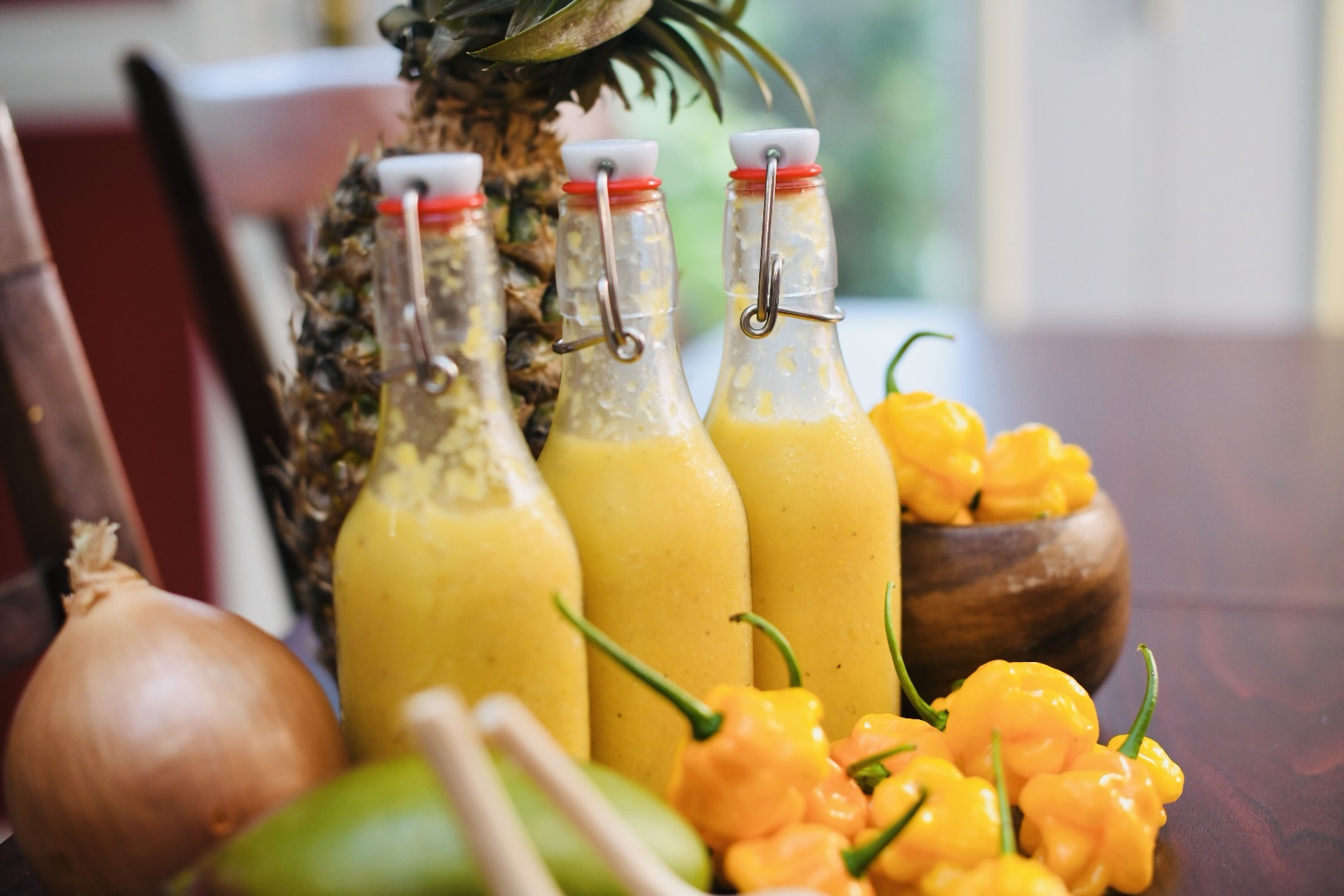
Sweet, fruity, tangy, and definitely spicy—this Spicy Mango Pineapple Hot Sauce is an easy way to turn fresh peppers into something you can enjoy beyond the garden.
I made mine with jalapeño and Scotch bonnet peppers, along with mango and pineapple for sweetness.
And I love the combination.

The fruit doesn’t make the sauce completely sweet. Instead, it balances some of the heat from the peppers while giving the hot sauce a bright tropical flavor.
You also don’t have to use the exact peppers I used.
You can use whatever hot peppers you have growing in your garden.
And if you only have mango or only have pineapple, that’s okay too.
The first batch I made used only mango, and it was just as good. This time, I combined mango and pineapple, and I also used some red jalapeños.
I have to say, I really like the little bit of bright red color the ripe jalapeños add to the sauce.
If you have an abundance of hot peppers from the garden, here’s another delicious way to use them.
Spicy Mango Pineapple Hot Sauce Ingredients
- 4 garlic cloves
- 1 large onion, roughly chopped
- 1 small mango, peeled and chopped
- 2 cups chopped pineapple
- 2 jalapeño peppers
- 3 Scotch bonnet peppers
- 2 cups vinegar
- 1 teaspoon salt
- 1/2 teaspoon ground black pepper
A Note About the Peppers
You don’t have to use jalapeños and Scotch bonnets.
Use the hot peppers you enjoy and adjust the amount according to your heat preference.
Scotch bonnet peppers can be very hot, so three of them create quite a kick.
For my sauce, I like combining them with jalapeños. The jalapeños contribute pepper flavor without adding quite as much heat as the Scotch bonnets.
I also used red jalapeños in this batch.
Jalapeños turn red when they’re allowed to fully ripen on the plant, and I love the bright color they add to the sauce.
If you want a milder sauce, use milder peppers or reduce the amount of very hot peppers.
Just remember that pepper heat can vary considerably—even between peppers from the same plant.
Mango, Pineapple, or Both?
This recipe is flexible when it comes to the fruit too.
You can make it with:
Mango only
Pineapple only
Or mango and pineapple together
My first batch was made with mango and Scotch bonnet, and it was delicious.
For this batch, I decided to add pineapple and jalapenos, too.
Mango gives the sauce a smooth sweetness, while pineapple adds a bright, slightly tangy tropical flavor.
I really enjoy the combination of the two.
If your garden gives you a big pepper harvest, you could even make different batches and see which version you prefer.
I posted a short video on how to make it on Instagram, YouTube, Facebook and TikTok if you want to watch it.

How to Make Spicy Mango Pineapple Hot Sauce
Step 1: Prepare the Ingredients
Peel the garlic and onion.
Roughly chop the onion, mango, pineapple, jalapeños, and Scotch bonnet peppers.
You don’t need everything perfectly chopped because the ingredients will be blended before cooking.
Step 2: Be Careful When Handling Hot Peppers
Scotch bonnets are very hot.
Consider wearing disposable food-safe gloves when cutting them, and avoid touching your eyes, face, or skin while handling the peppers.
Wash your hands, cutting board, knife, and other surfaces thoroughly afterward.
If you cook the sauce, keep your kitchen well ventilated and avoid leaning directly over the pot or breathing in steam and fumes from the peppers.
Step 3: Blend the Ingredients
Add the garlic, onion, mango, pineapple, jalapeños, Scotch bonnets, vinegar, salt, and ground black pepper to a blender or food processor.
Blend until smooth, working in batches if necessary.

If you prefer a slightly textured hot sauce, you can stop blending earlier.
I prefer mine blended into a smooth sauce.
If you are okay with sharper spicy flavor you can skip the next step and follow steps number 5 onwards. I liked the ingredients raw and sharp but if you prefer a smoother and softer flavor, follow step number 4 be cause in addition to the flavor it is also a good safety step.
Step 4: Cook the Blended Sauce
Pour the blended mixture into a saucepan or pot.
Bring it to a boil, then reduce the heat to low and simmer uncovered for approximately 20–25 minutes, stirring occasionally to prevent sticking and to help the sauce cook evenly.
The sauce is ready when the onion and fruit are fully softened, the flavors have developed, and the mixture has thickened slightly to a smooth, pourable consistency similar to bottled hot sauce. It should coat the back of a spoon but still flow easily from a bottle. If it seems too thick, stir in a small amount of vinegar; if it is too thin, continue simmering for a few more minutes.
This recipe makes approximately 3 cups of hot sauce, depending on how much the sauce reduces during simmering and whether you strain it.
Step 5: Strain the Sauce, If Desired
For a smooth, pourable sauce, pour the cooked mixture through a fine-mesh strainer into a clean bowl or measuring container, pressing on the solids with a spoon to extract as much liquid as possible.
Straining is optional. If you prefer a thicker sauce with more fruit and pepper pulp, skip this step and bottle the blended sauce as is.
If you strain the sauce, the yield may be slightly lower, and the remaining pulp can be used in marinades, soups, or as a spicy spread.
Step 6: Taste and Adjust
Carefully taste the sauce after it has cooled enough to do so safely.
This is where you can decide whether you like the balance of fruit, vinegar, salt, and heat.
Keep in mind that adding ingredients after preparation can affect the sauce’s storage characteristics, so make any adjustments before transferring the sauce to containers.
Step 7: Transfer to Clean Containers
Transfer the finished sauce into clean bottles or jars.
Allow it to cool promptly, then cover and refrigerate.
For best quality, use the refrigerated sauce within 2–3 weeks. Discard it sooner if you notice mold, fermentation, an off odor, unusual bubbling, or any other signs of spoilage.
You can also freeze them in trays like Souper Cubes and thaw when you need some. It’s a great way to enjoy your homemade hot sauce longer.
Important Food Safety Note
This recipe is intended as a refrigerated homemade hot sauce, not a tested shelf-stable canning recipe.
Because this sauce contains fresh ingredients that are blended before cooking, refrigeration is especially important.
Even though it contains a substantial amount of vinegar, you shouldn’t assume a homemade hot sauce is safe for room-temperature storage based on taste or the amount of vinegar alone.
The final acidity depends on the ingredients, proportions, vinegar acidity, preparation method, and finished product.
Unless you’re following a scientifically tested canning recipe, keep this sauce refrigerated.
If you want to preserve hot sauce through water-bath canning, use a tested recipe from a reliable home food-preservation source rather than adapting this recipe for shelf storage.

If you wish to prolong the storage, I suggest freezing the extra sauces in trays and thaw only what you needed. I like using Souper Cube trays for easy storage and portioning.
How Spicy Is This Hot Sauce?
With three Scotch bonnet peppers plus two jalapeños, this is definitely a spicy sauce.
Scotch bonnets bring considerably more heat than jalapeños.
But that’s also what I like about making homemade hot sauce.
You can make it your own.
If Scotch bonnets are too hot for you, use fewer of them or substitute a milder pepper.
If you love extremely spicy food, you can experiment with hotter peppers.
The recipe is really a starting point.
The peppers you grow can determine the sauce you make.
Can You Remove the Seeds to Make Hot Sauce Less Spicy?
You can remove the seeds, but there’s something important to understand about pepper heat.
Most of the capsaicin responsible for a pepper’s heat is concentrated in the pale inner tissues surrounding and supporting the seeds rather than inside the seeds themselves.
So if you want to reduce the heat, remove the seeds and the inner ribs or membranes.
For very hot peppers such as Scotch bonnets, even doing this will not make them mild.
They’re still hot peppers.
What Does Mango Pineapple Hot Sauce Taste Like?
The first thing you’ll notice is the fruit.
Mango and pineapple bring sweetness and tropical flavor.
Then you get the tanginess from the vinegar.
Garlic and onion give the sauce a savory base.
And finally…
The Scotch bonnet lets you know it’s there.
That’s what I like about this sauce.
It’s not simply heat for the sake of heat.
There are several flavors happening at the same time:
Sweet + tangy + savory + spicy.
What Can You Eat With Mango Pineapple Hot Sauce?
This sauce can be used anywhere you want a combination of fruit and heat.

Try it with:
- Fish
- Tuna
- Shrimp
- Chicken
- Tacos
- Rice bowls
- Grilled meats
- Roasted vegetables
- Eggs
- Sandwiches
- Marinades
- Dipping sauces
I especially love tropical fruit and hot peppers with seafood.
You don’t need much when the sauce is this flavorful.
A Great Way to Use Homegrown Hot Peppers
I grow a lot of vegetables because I want to actually use what comes out of my garden.
For me, that’s part of what makes growing food worthwhile.
Sometimes the harvest becomes dinner that night.
Sometimes I freeze vegetables for later.
Sometimes I preserve them.
And sometimes a handful of peppers becomes a bottle of homemade hot sauce.
That’s also why I don’t think you need a huge garden to make growing food worthwhile.
A couple of pepper plants can produce ingredients that become so many different things in the kitchen.
Hot sauce is just one of them.
Use Whatever Hot Peppers You’re Growing
Don’t feel like you need to grow Scotch bonnets specifically to make this recipe.
Maybe your garden is producing:
- Jalapeños
- Serranos
- Cayenne peppers
- Habaneros
- Scotch bonnets
- Anaheim peppers
- Another hot pepper you love
Use what you have.
Just remember that substituting peppers can dramatically change the heat level.
Start with an amount appropriate for the pepper you’re using and your tolerance for heat.
That’s one of the things I enjoy most about garden-to-table recipes.
Your garden gets to influence the recipe.
Don’t Let an Abundance of Peppers Go to Waste
Pepper plants can suddenly become very productive toward the end of summer.
You wait and wait for peppers.
Then suddenly you have more than you know what to do with.
That’s when I start thinking beyond using one or two peppers with dinner.
What can I make that uses several peppers at once?
Hot sauce is one answer.
You can turn that harvest into something you’ll continue using long after you picked the peppers.
And because you can change the fruit and peppers, you don’t have to make exactly the same hot sauce every time.
Maybe one batch is mango.
The next is pineapple.
And another is mango-pineapple with those beautiful red jalapeños from the garden.
That’s part of the fun.
Grow what you eat—and find delicious ways to use what you grow.
Let’s grow food at home.
Spicy Mango Pineapple Hot Sauce Recipe
Ingredients
- 4 garlic cloves
- 1 large onion, roughly chopped
- 1 small mango, peeled and chopped
- 2 cups chopped pineapple
- 2 jalapeño peppers
- 3 Scotch bonnet peppers
- 2 cups vinegar
- 1 teaspoon salt
- 1/2 teaspoon ground black pepper
Instructions
- Peel the garlic and onion and prepare the mango and pineapple.
- Roughly chop the onion, mango, pineapple, jalapeños, and Scotch bonnet peppers.
- Consider wearing gloves when handling Scotch bonnet peppers and avoid touching your face or eyes.
- Add all the ingredients to a blender or food processor.
- Blend until smooth, working in batches if necessary.
- Pour the blended mixture into a pot.
- Bring the sauce to a boil, then reduce the heat to low and simmer uncovered for approximately 20–25 minutes, stirring occasionally. The sauce should be smooth, slightly thickened, and still pourable, coating the back of a spoon without becoming paste-like.
- For a smooth bottled sauce, strain the cooked mixture through a fine-mesh strainer, pressing on the solids. Straining is optional if you prefer a thicker sauce with more pulp.
- Taste after it has cooled enough to do so safely and adjust as desired.
- Transfer the sauce to clean containers. This recipe makes approximately 3 cups, depending on reduction and straining.
- Cover and refrigerate the finished hot sauce. Use within 2–3 weeks for best quality, and discard it sooner if you notice signs of spoilage. This recipe has not been developed as a shelf-stable canning recipe.
Frequently Asked Questions
Can I make mango pineapple hot sauce with different peppers?
Yes. You can substitute other hot peppers according to your preferred heat level. Remember that different varieties vary dramatically in heat, so don’t necessarily substitute the same number of much hotter peppers.
Can I use only mango?
Yes. I’ve made a version using only mango, and it was just as good. Mango creates a sweet, fruity hot sauce that pairs really well with hot peppers.
Can I use only pineapple?
Yes. You can make the sauce with pineapple instead of combining pineapple and mango. Expect the flavor and consistency to be somewhat different.
Do I have to cook this hot sauce?
The ingredients should be blended before cooking, but cooking is still optional. You can use the blended sauce fresh for a brighter flavor, or simmer it for approximately 20–25 minutes for a softer texture and deeper flavor. If you use it uncooked, keep it refrigerated and use extra care with food safety.
Should I strain the hot sauce before bottling?
Straining is optional. Strain the cooked sauce through a fine-mesh strainer if you want a smooth, pourable sauce with fewer seeds and less pulp. Leave it unstrained if you prefer a thicker sauce with more fruit and pepper texture. Straining may reduce the final yield slightly.
How much hot sauce does this recipe make?
This recipe makes approximately 3 cups of hot sauce. The exact yield depends on how much the sauce reduces during simmering and whether you strain it before bottling.
How can I make this hot sauce less spicy?
Use fewer Scotch bonnet peppers, substitute milder peppers, and remove the inner ribs and membranes from hot peppers. Remember that Scotch bonnets are naturally very hot, so even a smaller amount can add considerable heat.
Do I need to wear gloves when cutting Scotch bonnet peppers?
Gloves are a good precaution when handling very hot peppers. Avoid touching your eyes and face, and thoroughly wash your hands, utensils, cutting board, and work surfaces after handling them.
How long does homemade mango pineapple hot sauce last?
Keep the sauce refrigerated and use it within 2–3 weeks for best quality. Discard it sooner if you notice mold, fermentation, an off odor, unusual bubbling, or other signs of spoilage.
Does this mango pineapple hot sauce need to be refrigerated?
Yes. Treat this particular recipe as a refrigerated homemade sauce. It has not been developed or tested as a shelf-stable home-canning recipe.
Can I water-bath can this hot sauce?
Don’t assume this recipe is safe for water-bath canning based only on the amount of vinegar it contains. For shelf-stable home canning, use a scientifically tested recipe and follow its ingredient proportions and processing instructions exactly.
Related Articles
- Jalapeño Chili Garlic Oil
- West African-Inspired Chili Sauce With Jalapeños and Smoked Herring
- How to Ferment Jalapeño Peppers for Hot Sauce Using a Fermentation Jar
- How to Ferment Hot Sauce
- How to Grow Jalapeño Peppers
- How to Grow Peppers
- When to Harvest Peppers
- How to Preserve Peppers
- Summer Garden Highlights



Leave a Reply